- Long term running costs can make the cheapest appliance not such a great deal.
- Look beyond the A-G rating and use the energy label consumption figures to work out more accurate, real world running costs.
- You won't benefit from an appliances maximum efficiency savings if you have wasteful energy habits.
Next time you replace your washing machine, dishwasher or fridge, make sure you consider its energy rating before you take out your credit card.
You could be paying the price with higher energy bills by choosing the wrong model.
As you’d expect, the most energy efficient appliances use less power and water than inefficient models, whilst performing to the same standards.
You’ll also find that higher rated makes or models don’t usually cost much more, but will pay you back with significant savings on your energy bills. That’s particularly true if you’re a high user or haven’t replaced an appliance for at least a few years.
Efficient appliances are also more environmentally friendly, reducing your impact on global warming and conserving valuable resources such as water. Again, this saves you money by reducing your water bills.
How much can you save with the most energy efficient appliances?
An energy efficient appliance will save you money every time you use it, and the savings can really add-up.
For example, according to the Energy Saving Trust:
- An electric kettle that only boils the amount of water needed can use 20% less energy than a standard model.
- Choosing an A-rated fridge freezer instead of an F-rated model will save you around £580 over its lifetime.
- The most efficient A-rated dishwashers cost around £25 less per year to run than the lowest rated products.
As impressive as those figures are, it’s important to remember that they are examples based on typical products and average usage.
The actual level of savings you’ll experience will depend on your typical consumption and how much more efficient a new model is than what you are replacing. Also known as ‘efficiency gain’.
Use the appliance electricity cost calculator below to estimate the running costs of a range of home appliances.
So, once you’ve estimated the savings from upgrading your appliances, how do you tell which could save you the most money on your bills?
How to compare and choose energy efficient appliances
There are three main factors to consider when shopping for an energy efficient appliance:
1. Look for the Energy Label
Energy efficient appliances are easy to identify using the labels attached to them or included on product pages online.
The new Energy Label was introduced in 2021 and displays an efficiency rating on a scale from A to G with A being the most efficient and G the least.

By law, all the following appliances being sold by a retailer in the UK must display this label:
- Fridges and freezers
- Wine storage fridges
- Washing machines
- Washer-dryers
- Dishwashers
- TVs and electronic displays
- Lighting sources
Other appliances such as ovens and boilers also show a similar label, but may use an older A+++ to G rating. These are gradually being re-scaled to be easier to understand.
How to use the rating label to compare efficiency and running costs
Although the new label shows an appliance’s A-G efficiency rating, that only provides a general indication of running costs.
For specific comparisons between products in the same letter band, you’ll have to look further down the label at the typical consumption numbers.
That will show the number of kilowatt-hours (kWh) consumed in one of three different ways, depending on the type of appliance:
- kWh per 100 cycles for washing machines and dishwashers
- kWh per annum for fridges, freezers and tumble dryers
- kWh per 1000 hours of use for TVs, monitors and light bulbs
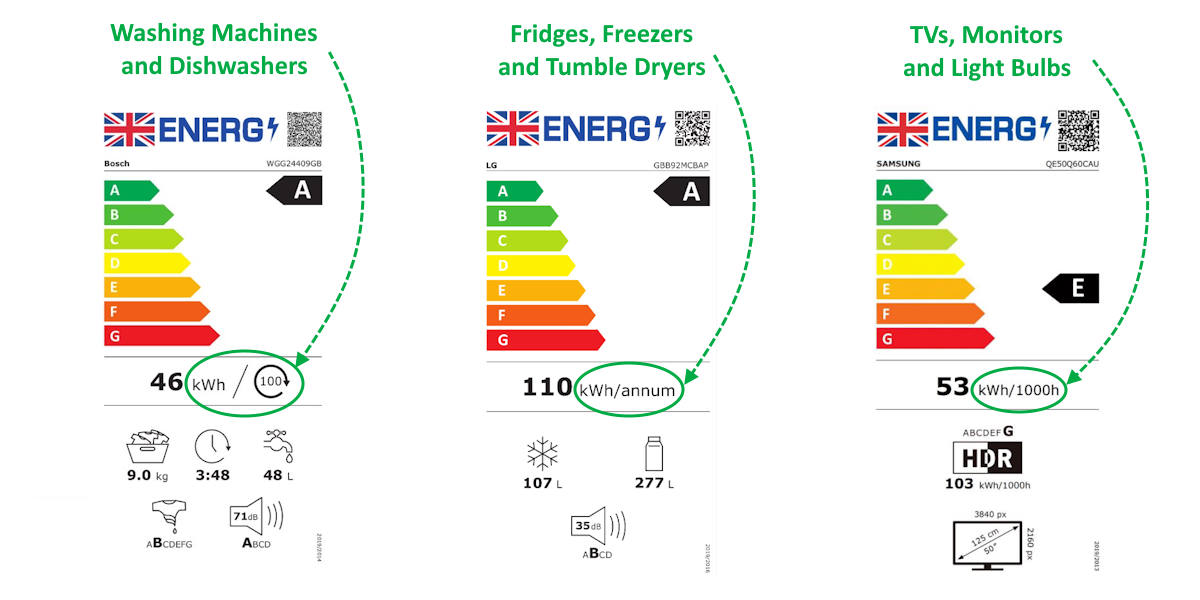
The lower the number of kilowatt-hours (kWh) used, the more energy efficient the appliance.
To get an estimate of running costs, simply multiply the kWh number by the unit price you pay for electricity, which you can find on your latest bill.
For example, if an appliance uses 100 kWh’s per annum and my electricity cost is 30 pence per kWh, the estimated annual running costs would be 100 × 0.30 = £30.
Bear in mind that these typical consumption numbers are based on an appliance’s ‘eco-mode’ which you might not always use.
2. Get the Right Size
Energy can easily be wasted if you choose an appliance that’s bigger than you really need.
Internal components increase in size and power capacity if you unknowingly pick a model that offers more than you’ll need.
For example:
- A washing machine with an oversized drum requires more energy to fill, heat and spin.
- A fridge with more storage than you can use, so will spend most of its life half empty and drawing more electricity to cool the unused space.
- A full size dishwasher in a house with only one or two occupants will use more water and electricity than a slimline model.
3. Check Eco Modes or Programmes
Energy efficiency is more important to consumers than ever when shopping for a new appliance.
This and the requirement to declare efficiency ratings has forced manufacturers to add more and more energy saving features. That’s partly because eco-modes and low energy programmes are used to set their official efficiency rating.
While that’s a good thing, it can also lead to mistakes if you base your comparisons on the official rating but never use the eco-mode because it doesn’t suit your lifestyle or energy habits.
So, make sure you’re happy with how eco-friendly features work, so you can actually benefit from the advertised efficiency savings.
Tips for running your appliances more efficiently
The amount of electricity consumed by your appliances will depend upon how they are used and where they are located in your home.
For example, a half-full fridge or freezer uses more energy than a full one and will consume even more electricity if placed too close to a radiator or oven.
Apply the tips below to optimise your energy habits and squeeze the maximum efficiency savings from your appliances:
Washing Machines
- Modern washing powders work just as well at lower temperatures. So wash loads at 30C rather than 40C.
- Don’t wash part loads, wait until you have a full load before using the washing machine.
- Use a fast spin setting, such as 1400, so clothes dry quicker.
Tumble Dryers
- Try using the ‘low heat’ mode for lower consumption.
- Dry multiple loads one after the other. That way, they dry quicker from the residual heat built up from the first one.
- Check and clean the filter after each load to ensure maximum air flow.
Dishwashers
- Wash with a full load, or select a half load or economy setting if your dishwasher has one.
Fridge Freezers
- Don’t leave your fridge or freezer door open, as this allows cold air to escape and costs money to reduce the temperature again.
- Don’t put warm food into your fridge or freezer. Instead, let it cool down first.
- Defrost your fridge and freezer regularly to keep it running at maximum efficiency.
Electricals
- It’s an old one, but don’t leave appliances on standby. A television on standby uses 7% of the electricity required to power it when switched on.
- Reducing the brightness level of screen devices like TVs, monitors, and laptops can reduce their energy consumption considerably.
- Activate any sleep modes so that devices accidentally left on will automatically shut down and use minimal power.
Your Appliance Shopping Checklist
There’s a lot to think about to make sure you get the right appliance at the right price with the lowest running costs for your budget.
To make that a bit easier, here’s the main points I’ve covered above:
- Always check the energy label for its A-G rating and specific consumption numbers.
- Make sure you match the right size of appliance to your actual usage needs.
- Check that any eco-friendly features or programmes are compatible with your lifestyle and habits.
- Remember that the energy label rating is based on the most efficient eco setting.
- Shop around and check if disposal of your old appliance is included or an extra cost.
- Compare running costs with the appliance running cost calculator.