- A slow cooker could save you the most money of the products tested
- LED light bulbs offer the biggest effiency improvements for the lowest cost
- Compare potential savings with the appliance electricity cost calculator
The cost to upgrade your home with the most energy efficient products or appliances can be unaffordable for many.
The good news is that substantial savings are still possible without spending hundreds on a new washing machine or thousands on the latest A-rated boiler.
I’ve personally tested the electricity consumption and potential savings of some of the cheapest energy saving devices that could pay for themselves in as little as six months and continue to save you around £100 every year that you use them all.
If you don’t need to or can’t afford to replace all the products suggested below, which should you consider first?
⚡ Best for Lowest Cost with Maximum Efficiency – LED Light bulbs
💰 Best for Biggest Savings – Slow Cooker
☕ Best for Regular Tea/Coffee Drinkers – Gas Hob Kettle
⛄ Best for Frozen Meals – Microwave
🥧 Best for Cheaper Complete Family Meals – Air Fryer
Here’s how the savings stack up for each product per use and per year:
Most Energy Efficient Products Compared
*Energy consumption data measured using a SMETS2 smart meter and Tapo energy monitor. Savings figures based on July 2023 price cap tariff rates.
| Product or Appliance | Lowest Price | Compared To | Saving Per Use* | Saving Per Year* | Payback Time |
|---|---|---|---|---|---|
| 1. LED Light Bulb (5w) | £3 | 40w Incandescent Light Bulb | 1.3p per bulb / 87% (1hr) | £4.93 per bulb (1hr a day) | 7 months |
| 2. Gas Hob Kettle (1L) | £6 | 3kw Electric Kettle | 0.45p / 40% (300ml) | £6.32 (4 times a day) | 8 months |
| 3. Slow Cooker (3.5L) | £30 | 2.5kw Electric Fan Oven for 1 Hour | 37p / 61% (8hrs) | £57.72 (3 times a week) | 6 months |
| 4. Microwave (700w) | £60 | 2.5kw Electric Fan Oven for 30 Mins | 26p / 88% (10 mins) | £41.18 (3 times a week) | 17 months |
| 5. Air Fryer (7.5L) | £80 | 2.5kw Electric Fan Oven for 30 Mins | 11p / 37% (20 mins) | £17.16 (3 times a week) | 4 years |
1. LED Light Bulbs
According to the Energy Saving Trust, lighting accounts for 11%-15% of a typical annual electricity bill.
Given the huge rise in energy costs since 2021, that’s a substantial amount of money which you could reduce by simply changing any older incandescent, halogen or flourescent lights to modern LED light bulbs costing as little as a few pounds each.
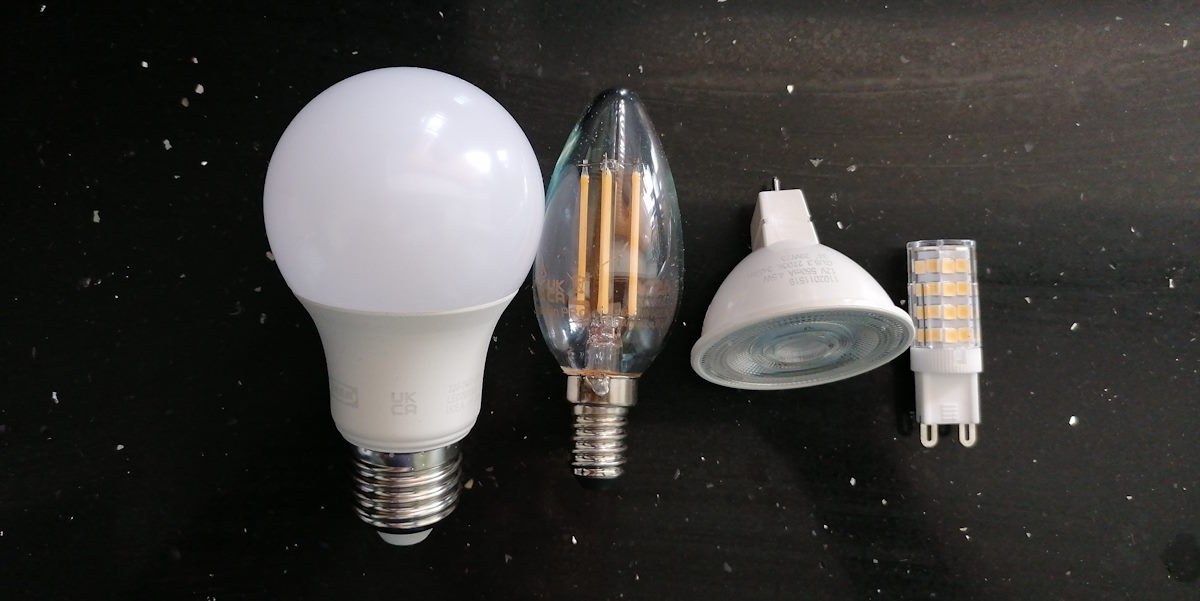
How do LED light bulbs save energy?
LED light bulbs produce light through a process called electroluminescence, which is about 90% efficient at converting electricity into light.
In contrast, a traditional filament incandescent bulb relies on heat to create light and is only 10% energy efficient.
LED lights are so efficient that a 6watt bulb can produce the same amount of light as a 60watt incandescent or halogen bulb.
LED’s also have a much longer lifespan of around 20,000 hours, about ten times longer than an incandescent bulb.
How much could LED light bulbs save you?
When compared to a 40 watt incandescent or halogen lightbulb, an equivalent 5 watt LED bulb uses 87% less electricity.
At a unit rate of 30 pence per Kilowatt hour, a single LED used for an hour per day would cost just 55 pence per year, compared to £4.38 for the least efficient filament bulb. That’s a saving of £3.83 a year for a single bulb.
Obviously, the more light bulbs you have and the more you use them, the greater the savings will be.
If you’re unsure whether you’re still using incandescent or halogen bulbs, some of the most common locations for them are lamps, bathroom or kitchen spot lights and outside security lights.
Once you know what lights you’ve got, try the LED savings calculator to see how much money you could save by switching any old bulbs for LEDs.
| Bulb Type | Avg Cost to Buy | Efficiency (Lumens per Watt) | Lifespan (Hours) | Cost Per Hour Per Bulb (30p/kWh) | Cost Per Year Per Bulb (1 hr / day) |
|---|---|---|---|---|---|
| LED 5w (40w equiv) | £3 | 100 | 15-20,000 | 0.15p | 55p |
| CFL 8w (40w equiv) | £5 | 55 | 5-10,000 | 0.24p | 87p |
| Halogen Eco Spotlight 40w (50w equiv) | £3 | 11 | 2-4,000 | 1.2p | £4.38 |
| Incandescent 40w | £2 | 10 | 1000 | 1.2p | £4.38 |
What are the benefits of using LED light bulbs?
LED technology has revolutionised the lighting industry and delivers multiple benefits in addition to its energy efficiency.
- Longer lifespan – Typically around 20,000 hours, meaning fewer replacements and less waste.
- Improved lighting quality – They offer bright and consistent illumination, enhancing visibility and creating a more comfortable ambiance in your home.
- Instant light – Unlike some CFL or tube lights, LED bulbs reach full brightness instantly.
- Environmentally friendly – There’s no nasty chemicals or metals required to manufacture an LED bulb.
Can LEDs replace fluorescent tubes?
Yes, you can now buy direct replacements for fluorescent tube lights that look identical but use LED technology, along with all of its benefits.
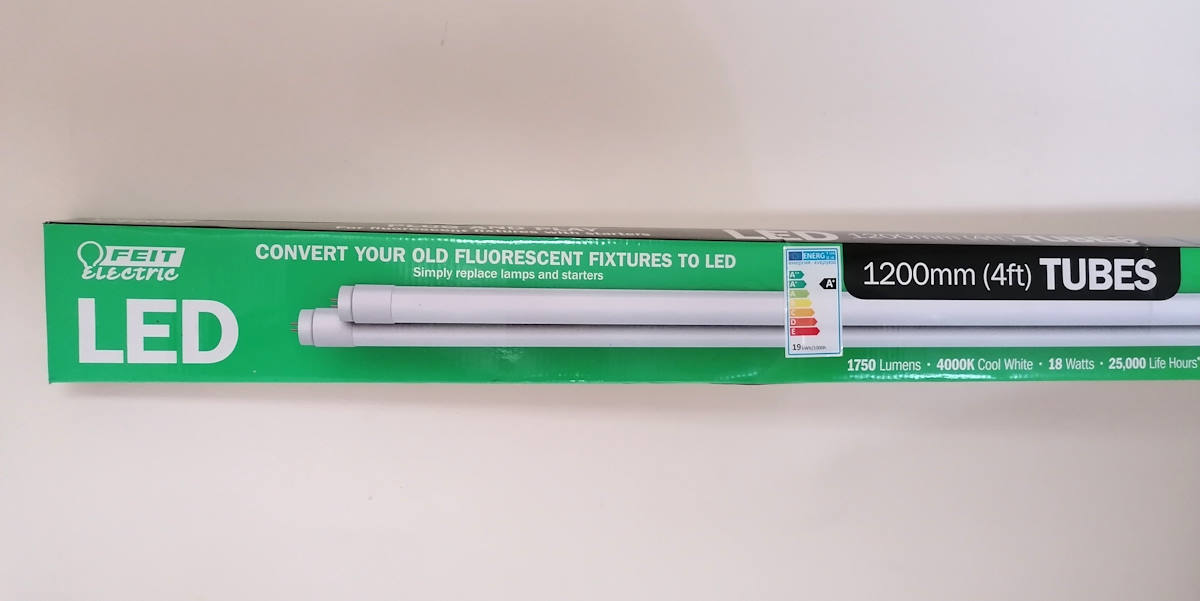
They can be fitted to your existing fixtures in seconds and come with replacement starters for a full conversion without needing an electrician.
I recently replaced two 36-watt fluorescent tube lights in my garage with the 18-watt LED replacements shown above. Not only were they easy to install and provide instant light without any flickering, but they have also reduced the energy consumption by half.
2. Gas Hob Kettle
As a nation of tea and coffee drinkers in the middle of an energy crisis, how to boil water quickly but cheaply should be of interest to us all.
Like most people, I’ve used an electric kettle for years until recently when I switched to a small one litre camping kettle which I use with a standard kitchen gas hob.
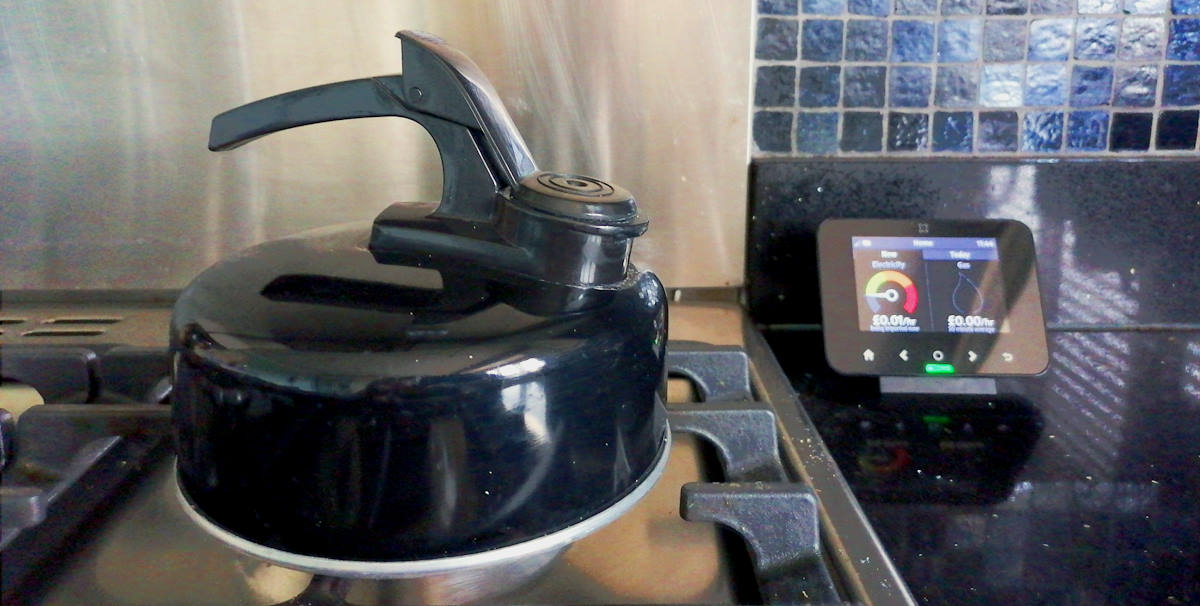
How does a gas hob kettle save you money?
The main advantage of using gas to boil a kettle over electricity is the price per unit of energy, which is currently around 73% cheaper on the July 2023 price cap (8p vs 30p).
Gas provides a more direct heat but will take longer to boil because most electric kettles are designed for convenience first, which you have to pay for in higher energy output to boil faster.
How much money can a gas hob kettle save?
Compared to boiling a cup sized 300ml of cold water in a 3kw electric kettle for 45 seconds, a gas hob kettle could save you around 0.45p per use or £6.32 per year on your electricity bill if you use your kettle the average four times per day*.
Boil more than 300ml or more often and the savings will increase further.
| Amount of Water | Time to Boil (Gas) | Cost (Gas Hob Kettle @ 8p/kWh) | Cost (3kw Kettle @ 30p/kWh) | Saving Per Use | Saving Per Year |
|---|---|---|---|---|---|
| 300ml or 1 cup | 1m 52s | 0.67p | 1.125p | 0.45p / 40% | £6.32 |
| 600ml or 2 cups | 3m 31s | 0.90p | 1.83p | 0.93p / 51% | £13.05 |
| 900ml or 3 cups | 5m 26s | 1.52p | 2.76p | 1.24p / 45% | £17.41 |
*Savings figures are based on actual readings from a SMETS2 smart meter and Tapo energy monitor using July 2023 price cap tariff unit rates. Annual savings assume 365 days of use minus 14 days for holidays. UK daily average kettle use of 4 times per day according to the Energy Saving Trust.
What are the features of a gas hob kettle that improves energy efficiency?
The key when buying a hob kettle is a thin aluminium base and a whistle boil indicator.
Some sites suggest boiling water in a pan, but pans are made of much thicker metal that takes longer to heat. Even if you use a lid, which you should, there’s no built-in boil indicator, meaning you could use more gas than necessary.
You don’t need to spend much either, mine is a cheap one litre camping kettle that cost just £6.
Can a gas stove kettle heat water faster than an electric kettle?
No, in my tests a typical 3kw electric kettle will boil a cup sized 300ml of cold water in 45 seconds compared to 1 minute 52 seconds with a stove kettle on a medium size 7 cm gas hob ring.
If you’re happy to wait the extra minute, the savings are there to be had.
3. Slow Cooker
Slow cookers, or crock pots as they’re also called, have been around for decades. But their popularity has grown hugely as people look for cheaper ways to cook.
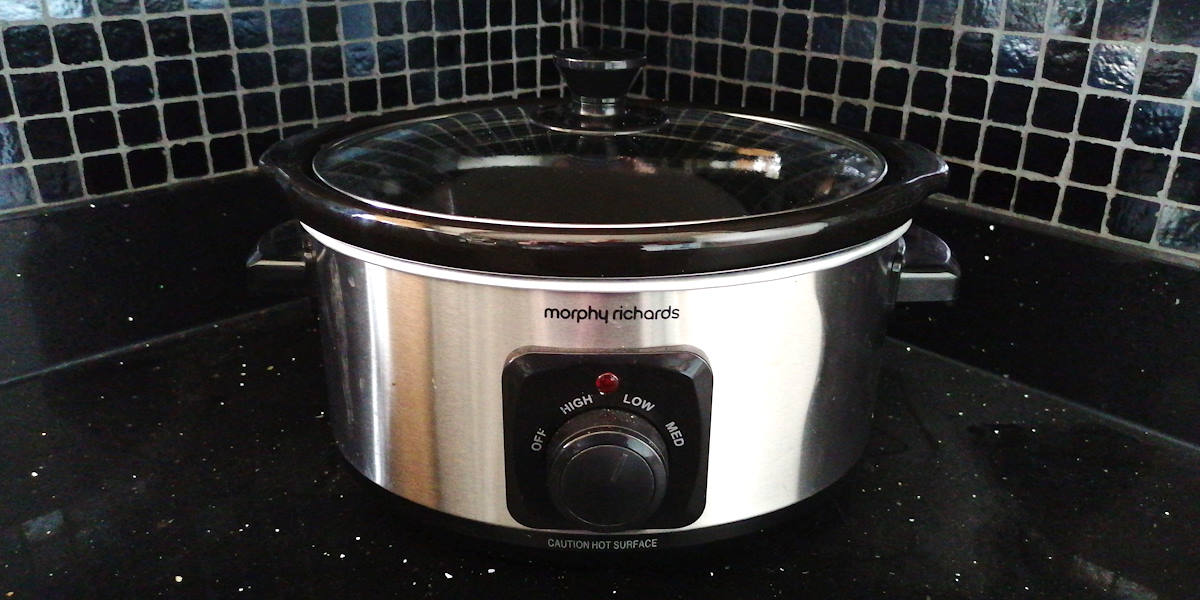
How does a slow cooker save energy?
Slow cookers save energy because they are designed to cook food over a longer period of time at a lower temperature, so require less electricity.
While an oven often uses around 2000 watts or 2kw of power, a slow cooker only needs between 100 and 200 watts. Slow cookers also operate at a constant temperature and do not require pre-heating before use. This adds to their efficient use of energy.
How much electricity does a slow cooker use over 8 hours?
Electricity consumption will vary depending on the cookers size, features, and the heat setting used.
Looking at the top ten highest rated slow cookers on Amazon.co.uk, the average power rating is 182 watts. So, in theory, the total electricity consumption over eight hours should be 182 × 8 which is 1456 watts or 1.456 kWh.
But that doesn’t tell the whole story because once the target temperature is reached for each setting, less power is required to maintain that level of heat.
In an effort to provide more precise, real world figures, I tested my own Morphy Richards 3.5L slow cooker which has a power rating of 142–170 watts depending on the setting.
Using an energy monitor plug and cooking a chicken curry over 8 hours on a low heat setting, the total electricity used was just 0.775kWh at a cost of 23 pence.
| Slow Cooking Duration | Electricity Consumption on Low | Cost @ 30p/kWh |
|---|---|---|
| 4 Hours | 0.297kWh | 8p |
| 6 Hours | 0.492kWh | 15p |
| 8 Hours | 0.775kWh | 23p |
Does a slow cooker use less energy than a conventional electric oven?
Yes, from my tests, a slow cooker used to cook a chicken curry for eight hours on a low setting will use about 60% less electricity than a 2kw fan assisted oven set to 180 degrees for an hour.
| Appliance | Cooking Duration | Electricity Consumed | Cost Per Use @ 30p/kWh |
|---|---|---|---|
| Slow Cooker (3.5L) | 8 Hours (Low) | 0.775kWh | 23p |
| Fan Assisted Oven (2.5kW) | 1 Hour (180c) | 2kWh | 60p |
How much money can you save with a slow cooker?
If you compare cooking a meal in a slow cooker over eight hours on a low setting with the same meal in a 2kw fan oven set to 180 degrees for one hour, the saving in electricity is around 60% or 37 pence per use.
If you replace three oven cooked meals per week with a slow cooker, you could save £57 a year.
What are the advantages of using a slow cooker over other appliances?
Other than using less energy, slow cookers also provide the following benefits:
- Cheap to buy – an entry level model big enough to cook for a family can cost just £30.
- Convenient – meals can easily be prepared in advance; so you can come home to a warm, ready-to-serve dinner.
- Easy to clean – because cooking is concentrated in one removable, dishwasher-friendly pot, cleaning up is easier.
- Economical – food, particularly cheaper cuts of meat, is more tender when cooked slowly, making meals cheaper.
- Enhanced flavours – flavours are intensified due to the low heat.
4. Microwave Oven
From reheating leftovers to making mouth-watering dishes, microwave ovens require less cooking time than a convential oven and therefore consume significantly less power.
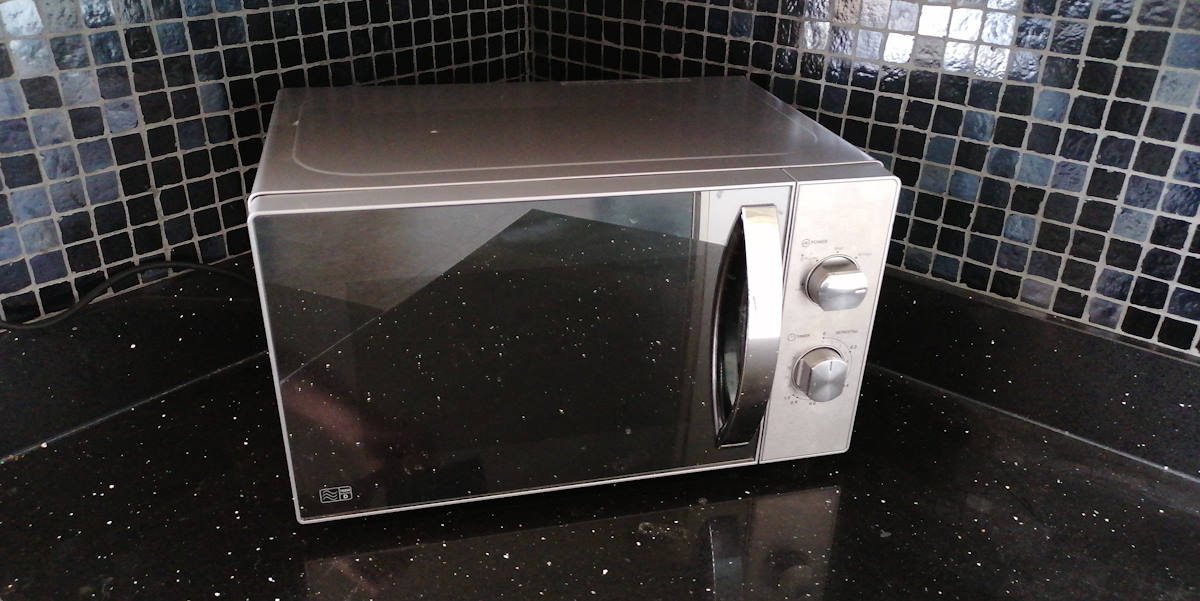
How does a microwave save energy?
Microwave ovens use concentrated radio waves that excite water molecules in food, producing more energy efficient heat that cooks it from within rather than heating the air around the food first.
This process is not only quicker but also more energy efficient than a conventional oven which has to heat the air inside the oven compartment before cooking the food from the outside.
How much can a microwave oven save you?
A microwave is only going to save you money if you can use it to replace the use of more energy hungry cooking appliances like a convential oven.
Your ability to do that will depend on how many people you cook for and what meals you regularly eat.
If you eat a lot of frozen food or ingredients like baked potatoes that you would normally cook in an oven, then a microwave will save you money.
To give you an idea of how much you could save, I tested the elctricity consumption required to cook two large baked potatoes in a 700w microwave and compared it with a large air fryer and 2kW fan assisted oven.
| Appliance | Cooking Duration | Electricity Consumed | Cost Per Use @ 30p/kWh | Cost Per Year (3 Times Per Week) |
|---|---|---|---|---|
| Microwave (700w) | 20 Mins (Full Power) | 0.231kWh | 7p | £10.50 |
| Air Fryer (7.5L/1.8kw) | 40 Mins (200c) | 1.198kWh | 36p | £54 |
| Fan Assisted Oven (2.5kW) | 40 Mins (200c) | 1.33kWh | 40p | £60 |
Does a microwave use more electricity than a fan oven?
No, depending on the model used, a microwave oven uses around half of the electricity required to power a convential fan oven.
A fan oven, being a larger appliance that cooks food in a different way to a microwave, requires more energy to heat up the oven chamber and maintain the chosen temperature.
On average, a microwave uses 0.3 to 0.5 kilowatt-hour (kWh) of electricity for 30 minutes use, while a fan oven uses roughly 1 to 1.25 kWh for the same period.
The electrical consumption will vary depending on factors such as cooking temperature, the size and quantity of the food cooked, and the overall efficiency of the appliance.
Again a direct comparison doesn’t always give you the full picture though as the average microwave won’t always be the most suitable way to cook all meals.
So, overall it is more energy-efficient to use a microwave for smaller meals and a fan oven for larger volumes or batches of food.
5. Air Fryer
Not only do air fryers cook without any oil, but some models can also grill, bake, and even roast your food more energy efficiently that a traditional oven. This means less wasted energy and lower electricity bills.
Let’s find out how they do it and what you could save by switching from your fan oven.
How does an air fryer save energy?
Air fryers require shorter cooking times and less energy than convential ovens due to their ability to circulate hot air around food at high speed.
Using a smaller cooking compartment, they are able to reach and maintain the desired temperature more efficiently without preheating, which is a major energy-consuming aspect of conventional ovens.
How much could an air fryer save you?
Based on my tests comparing 20 minutes use of a 7.5L air fryer to a convential electric fan oven, savings of £17 per year are possible.
Like any home cooking appliance, air fryers are available with different features, sizes and power ratings which can all effect the level of energy required.
If you’re looking to replace much of your convential oven use for improved convenience and energy efficiency, it’s important to choose an air fryer with enough capacity to accomodate your typical meal serving size and range of ingredients.
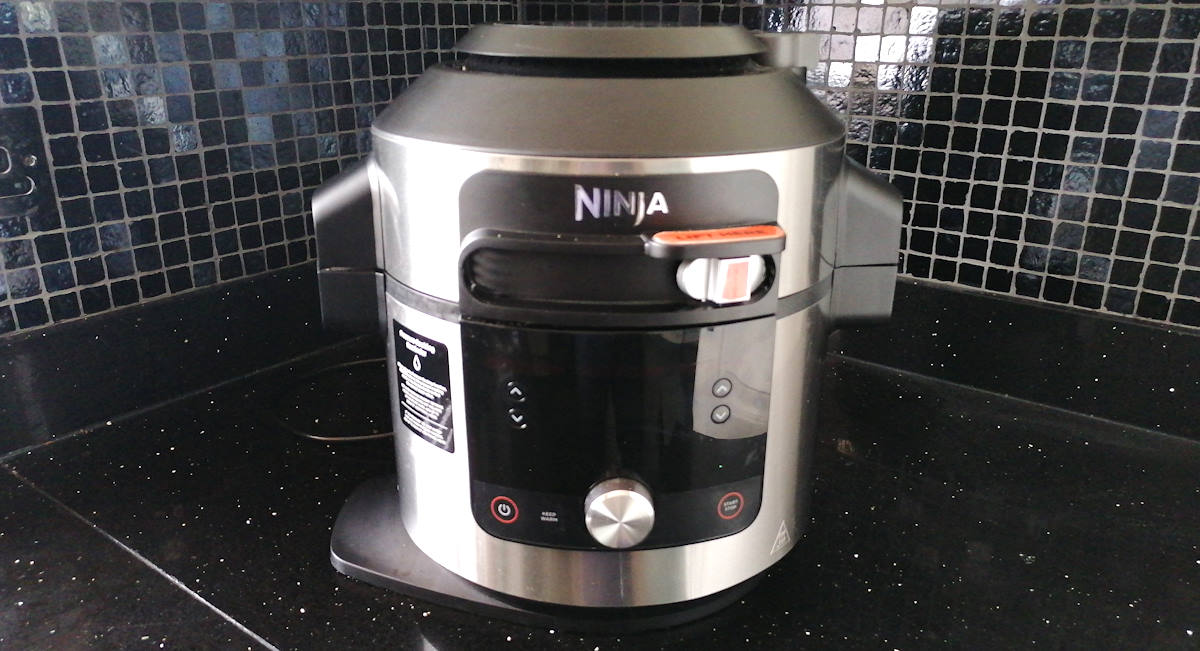
I have a Ninja 14 in 1 air fryer which has a 7.5L capacity and is capable of cooking a meal for five within 20 minutes.
In my tests using an energy monitor, the total eletricity consumption was 0.631kWh over 20 minutes costing just 19 pence at 30p/kWh. When compared to my 2kW fan oven, the saving was 11 pence per use or £17 over a year when used three times a week.
| Appliance | Cooking Duration | Electricity Consumed | Cost Per Use @ 30p/kWh | Cost Per Year (3 Times Per Week) |
|---|---|---|---|---|
| Air Fryer (7.5L) | 20 Mins (180c) | 0.631kWh | 19p | £28.50 |
| Fan Assisted Oven (2.5kW) | 30 Mins (180c) | 0.989kWh | 30p | £45 |
Is it cheaper to run an air fryer or a microwave?
For meals that are suitable for cooking in either appliance, a microwave will usually be cheaper because they use a more energy efficient form of cooking.
Is it cost-effective to replace your appliances with more efficient models?
Of course, there is an initial cost to replace small to medium-sized kitchen appliances like slow cookers, microwaves or air fryers.
But outdated and inefficient appliances are contributing to higher bills right now, and the longer you stick with them, the more money you waste.
The initial cost of replacing even the most expensive appliance can be recovered in just three years through lower energy, and the savings will go on long after you’ve got your money back.
Grants for energy efficient products
If some of these energy efficient products sound pricey, you’ll be pleased to hear that there are energy saving grants and subsidies available to help pay for some of them, particularly if you’re over 70 or on certain state benefits.
If you are eligible, local councils, government schemes and energy suppliers offer savings on everything from energy saving light bulbs to solar heating panels and new energy efficient condensing boilers.
Which should you replace first?
Ideally you should start by replacing the most inefficient products with the highest running costs first, but these tend to be the most expensive to upgrade.
The easiest household product to replace are your lightbulbs. For just a few pounds each, you can quickly install LED light bulbs that use five times less electricity and last ten to twenty times longer than old filament bulbs.
As well as products that consume less energy, you should also replace or install measures that help keep the heat in your home for longer.
The cheapest of these are draught excluders and covers for your letter box and keyholes. Next is loft insulation, followed by cavity wall insulation and double-glazed windows.
When you do replace appliances, look for the energy rating label which shows a scale of efficiency from A to G, with A being the most efficient. After 2021, these labels also show typical energy consumption figures so you can compare which appliances have the cheapest running costs.

How to Start Saving Money Without Breaking the Bank
If you’re still using older products and appliances around the home, you could benefit from substantial savings on running costs by upgrading to newer, more efficient models or methods.
That doesn’t always mean permanently replacing a product or appliance either.
Just switching some of your everyday energy habits to more efficient options like using a slow cooker two or three times a week instead of the main oven can save you £50-£60 a year and pay for itself in as little as six months if you don’t already have one.
If you’re still unsure whether changing your energy hungry appliances or habits is worth it, try the appliance electricity cost calculator to compare what you pay now and what you could save.