The cost of lighting contributes about 15%¹ of the average UK electricity bill, or £140 a year at current Energy Price Cap rates.
For this reason and a few more I’ll cover below, energy saving light bulbs should be one of the first efficiency improvements for your home.
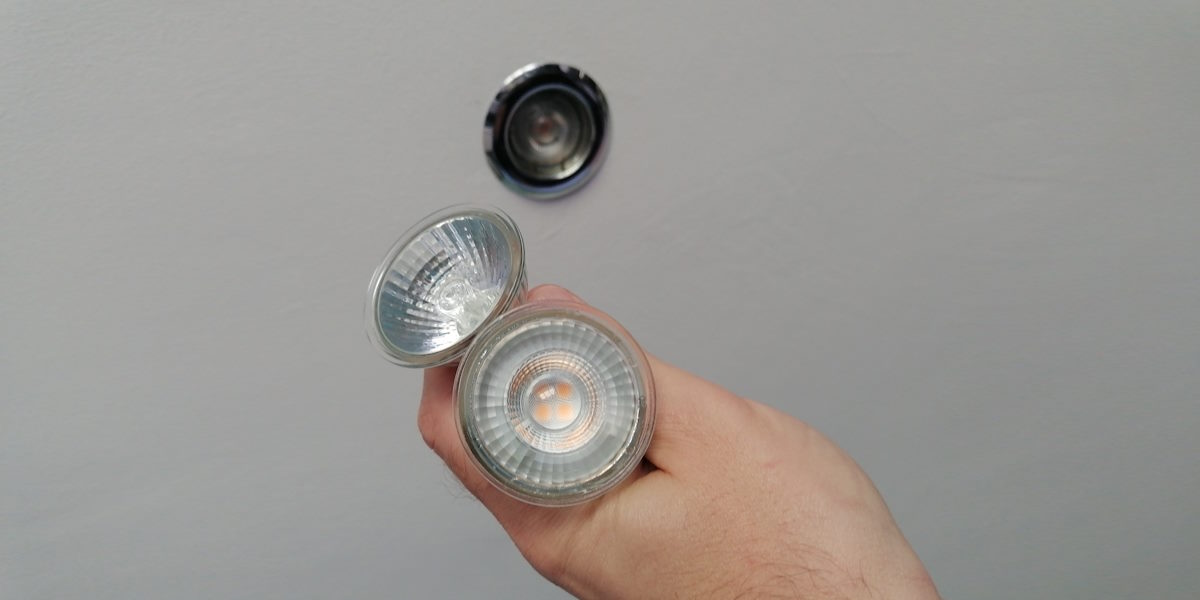
When I first moved into my current house, I changed twenty 50w halogen spotlights in the kitchen, utility room and bathroom for 5w LEDs.
That was eight years ago, and I estimate that I’ve saved close to a thousand pounds in electricity since then just on those twenty bulbs.
So if you’re still using halogen or traditional incandescent bulbs, the savings can be substantial. To get a better idea how much that could mean for you, I recommend starting with a quick audit of every light inside and outside your home.
But which bulbs could give you the biggest savings for the lowest cost?
What Are Energy Saving Light Bulbs?
Energy saving light bulbs need less electricity to produce the same level of light as less efficient traditional bulbs, and are currently available in two types: older CFLs (Compact Fluorescent Lamp) and newer LEDs (Light Emitting Diode).
Here’s how they are different.
CFL Light Bulbs
Compact Fluorescent Lamps were introduced as the first low energy alternative to traditional incandescent light bulbs and are basically a fluorescent tube designed to fit an ordinary light fitting.
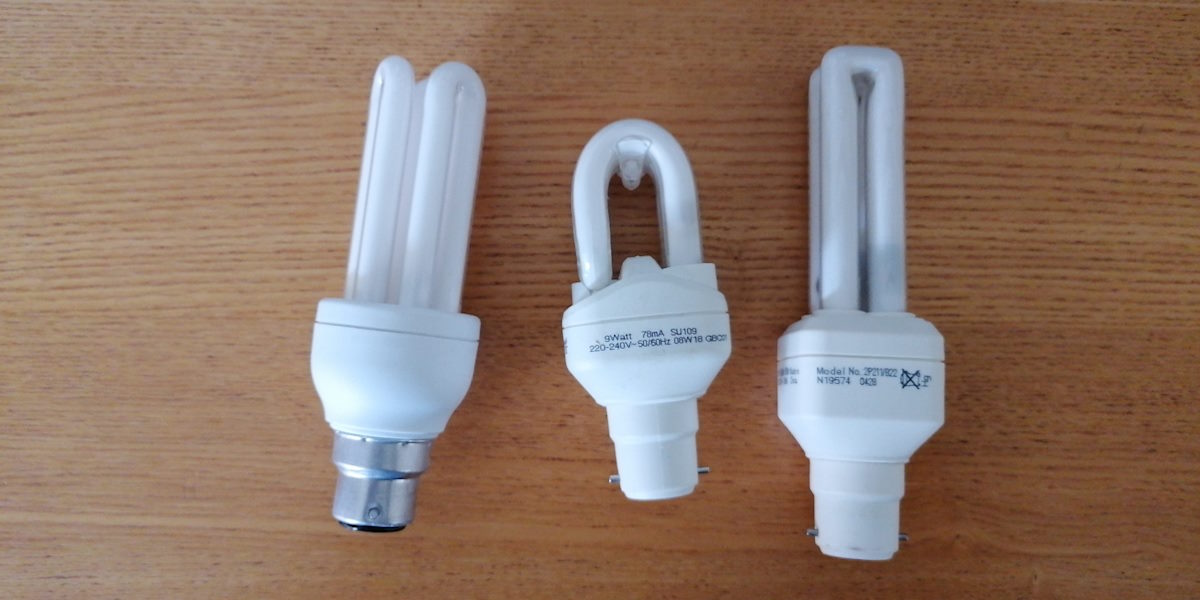
They use around 80% less electricity than traditional filament or halogen bulbs to generate the same light. Where you’d normally use a 60 watt old style incandescent filament light, you’ll only need an 11 watt CFL energy efficient equivalent.
Pros
- Cheap to buy from about £3 each
- Last around 10,000 hours, 10 times longer than traditional light bulbs
- Reduce energy consumption by 50%-80% compared to filament incandescent or halogen bulbs
Cons
- Not as efficient as LED bulbs
- Can have a slight delay before full brightness is reached
- CFL shapes and sizes are less compatible with some light fittings like spotlights
- Less compatible with some switches like dimmable lights
- Contain small amounts of mercury
- Are being phased out in the UK from 2023
LED Light Bulbs
LED light bulbs use a different and more energy efficient technology that generates more light than CFL bulbs from the same amount of power, also known as lumens per watt.
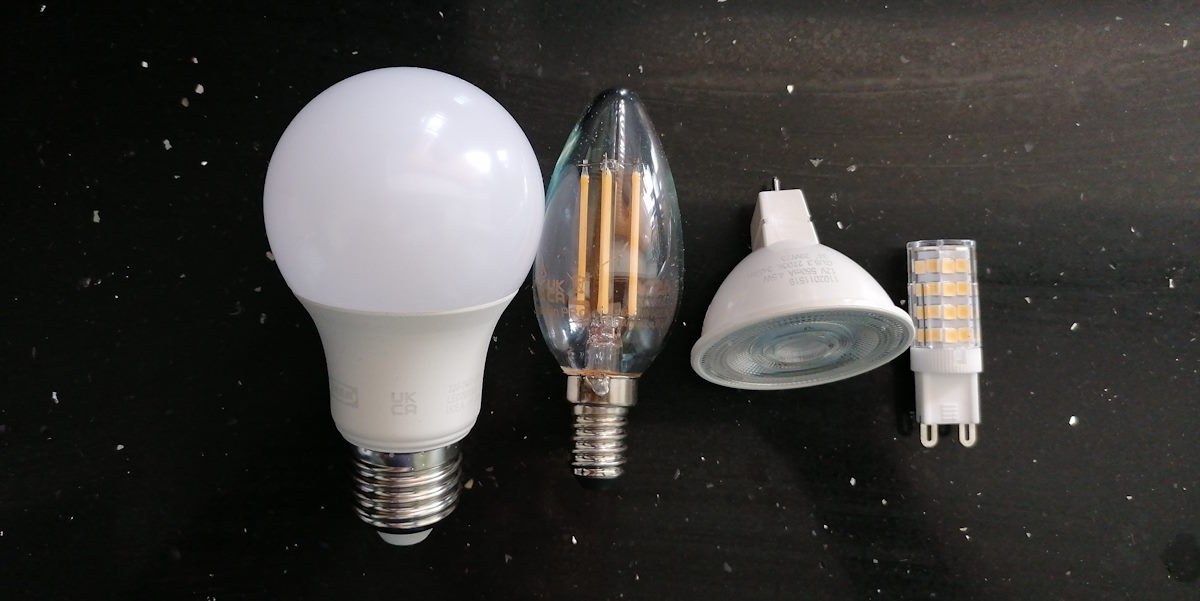
For example, an 8-watt LED bulb can produce light equivalent to a 60-watt incandescent filament bulb or an 11-watt CFL bulb.
LEDs also have a much longer lifespan, typically lasting up to 20,000 hours or more, compared to around 10,000 hours for CFLs.
This longer lifespan reduces the need for frequent replacements and further contributes to energy savings.
Pros
- Cheap to buy starting at £2-£4 for a 5-watt screw or bayonet fitting
- Ultimate energy efficiency giving more light per watt than incandescent, halogen or CFL bulbs
- Lasts 20 times longer than filament bulbs and twice as long as CFLs
- Gives an instant light with no flickering
- Cooler to the touch
- More compatible with a wider range of fittings and switches
Cons
- Standard LED bulbs can produce a colder or blueish light, and you may have to pay more to get the right colour temperature for your room
- If you use older dimmer switches, you may have to update them to work with lower wattages required for LED bulbs
How Much Money Could You Save?
To illustrate how much more efficient CFL and particularly LED light bulbs are compared to older filament technology, I’ve displayed the typical costs of a single bulb for each type in the table below.
| Bulb Type (60W Equivalent) |
Bulb Cost | Lifespan (Hours) | Annual Energy Cost* | 5 Yr Total Cost** | 5 Yr Saving On Halgn | 5 Yr Saving On Incan |
|---|---|---|---|---|---|---|
| LED (8W) | £4 | 20,000 | £2.62 | £17.10 | £60.85 | £86.45 |
| CFL (11W) | £4 | 10,000 | £3.61 | £22.05 | £55.90 | £81.50 |
| Halogen (42W) | £3 | 2,000 | £13.79 | £77.95 | N/A | £25.60 |
| Incandescent (60W) | £1 | 1,000 | £19.71 | £103.55 | N/A | N/A |
*Annual Energy Cost is calculated based on using a single bulb for 3 hours per day, with an electricity cost of £0.30 per kilowatt-hour. **5-year total cost includes the initial purchase cost, the 5-year energy cost, and the 5-year replacement cost.
What these numbers mean and a few examples of potential savings
Firstly, it’s important to bear in mind that the numbers above are for single bulbs and show that the most energy efficient and cost-effective lighting option is LED light bulbs.
Not only will they save you money on your energy bills by producing more light per watt of electricity than any other type of bulb, but they’ll last twice as long as the nearest alternative.
Here are some realistic examples of what that could mean in potential savings:
- If you have any old incandescent lights that have survived being upgraded so far, changing just two 60w bulbs for equivalent LEDs could save you £34 a year in electricity and last twenty times longer.
- Replacing ten halogen spotlights in your kitchen or bathroom with LED versions could save you over £100 a year and last ten times longer.
- Swapping just five 11w energy saving CFL bulbs for even more efficient LED alternatives is an easy £5 saving a year with double the lifespan included.
The Best Places to Fit Low Energy Light Bulbs
Energy efficient light bulbs are most effective in areas of your home where you use the most light.
For example, the hall, the kitchen, the landing, and children’s bedrooms. In these busy rooms, you can recoup the cost of LED bulbs in a matter of months.
It will take longer to get your money back in other rooms but, it’s still worth installing them as efficient bulbs can last 10 to 20 times longer than older filament bulbs and twice as long as CFL’s.
In rooms where you switch the lights on and off more frequently, the lifespan of low energy bulbs will be shorter, but not enough to outweigh their benefits.
Not only are there financial rewards from installing energy efficient lighting, consider the amount of time and hassle you will save by not having to replace bulbs that fuse every few months!
There really is no easier way of saving energy at home and doing your bit for the planet.
How to Choose Energy Saving LED Light Bulbs to Suit Any Room
The number of LED bulb types and options can be overwhelming if you don’t know exactly what to look for.
The good news is that years of cheap and problem free lighting are possible with some easy preparation.
Before you start shopping
It only takes a few minutes to record some basic information about the light bulbs in your home that you want to replace and you’ll save yourself the hassle and expense of choosing the wrong products.
Here’s what information to check:
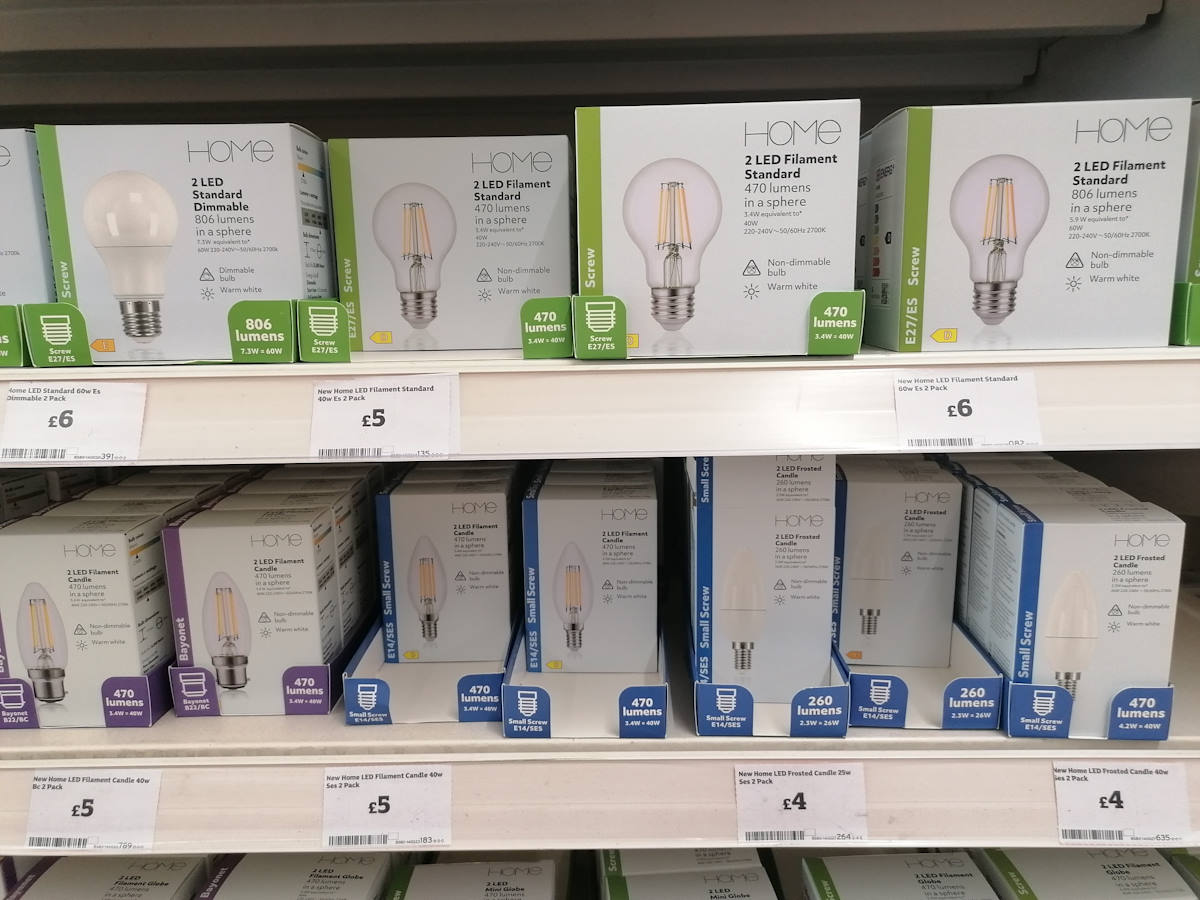
- Base fitting: take out your current bulb(s) and note what type of base they have. The most common are edison screw which have a threaded base like on a screw, bayonet cap which have two little bars sticking out of the base at opposite sides and GU10 which have two pins at the very bottom and are commonly used for spotlights.
- Shape: Note the shape of your old bulb. Popular shapes are the standard bulb shape also called GLS, candles, golf balls which are rounder, globes and GU10 which are for recessed lighting such as spotlights.
- Size: measure the length and width of the bulb(s) to ensure replacements fit current shades or housings.
- Wattage: note the wattage of your current bulb(s) which is often printed on the bulb base or glass body on older types. This is important to know to ensure an equivalent brightness from lower wattage LED lights. If you’re not happy with the existing bulbs brightness, then at least you have a baseline from which you can choose a brighter or dimmer replacement light.
- Colour: is the light a warmer orange or colder white/blue colour? Warmer lights are typically suited to lounges, dining areas and bedrooms with whiter or colder lights better for kitchens, bathrooms and garages.
- Switch: is the light switch a dimmer control where you can turn down the brightness of the light? If so you’ll need a dimmable bulb.
What to look for when buying
Once you’ve found LEDs that match the same base fitting, shape and size as your old bulb(s) it’s important to get the brightness and colour temperature right.
Here’s what to look for:
Watts
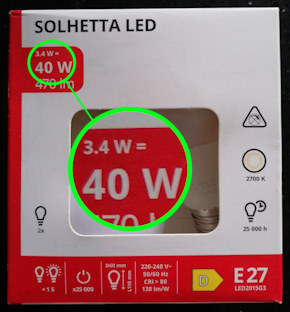 This shows how much power is used by the light. If you want to match the brightness of an old bulb you’ll need to look for an LED with an equivalent wattage.
Although wattage isn’t the best indicator of brightness, unless your old bulbs show a lumens figure, watts should be a good enough guide.
So if you’re replacing a 50w kitchen spotlight, the new LED packaging will show it’s much lower wattage together with an equivalent number which should match your old bulb.
It will often look like this on packaging “4.9 W = 50 W”.
Lumens
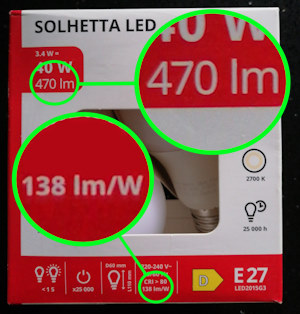 On most LED bulb packaging, you’ll also see another number followed by the word ‘Lumens’ or ‘lm’.
This is a more accurate indicator of brightness and also efficiency when comparing LED bulb brands with the same wattage.
So if you’re comparing two different 5W LEDs and one has a higher lumens figure, that is more energy efficient as it will give more light for the same electricity.
Better still is if a lumens per watt or ‘lm/w’ label is shown which makes it even easier to compare efficiency. Easily calculated by dividing a bulbs lumens by the wattage (470/3.4=138 lm/w), the higher the lumens figure the more energy efficient the bulb is.
Colour Temperature
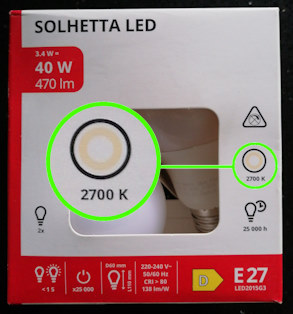 The colour of LED light can affect the feel or ambience of a room and can be labelled in two ways.
You might see terms such as ‘warm white’, ‘cool white’, ‘pure white’ or ‘daylight’.
These can be difficult to visualise so a more precise indicator is the Kelvin Scale which is a number range from 1,000-10,000 followed by the letter ‘K’.
For home lighting 2,000K-6,500K is the typical range and the lower the number the warmer the light.
As an example, warm light bulbs have a colour temperature ranging from 2000K-3200K, cool white is around 4000K and daylight 6000K.
REMEMBER: If you have a dimmer light switch you’ll need to look for ‘dimmable’ LED bulbs.
Where to Buy the Most Energy-Efficient Light Bulbs
Standard and some decorative energy saving LED bulbs are available from most DIY stores and supermarkets.
But you may need to find specialist suppliers for designer lighting products requiring more discreet or unique bulbs.
A list of popular suppliers who specialise in the latest LED technology is shown below:
BLT Direct (Rated 4.4/5 on TrustPilot) – A range of energy efficient lighting in various styles, with free delivery on orders over £65.00.
Lamps2uDirect.com (Rated 4.5/5 on TrustPilot) – Specialists in the supply of all types of light bulbs, including a large stock of Energy Saving lamps and fittings.
Lighting Direct (Rated 4.4/5 on TrustPilot) – Lighting Direct have over 3,000 products, often with a significant saving on the usual retail prices.
Lyco (Rated 4.4/5 on TrustPilot) – Lyco offer a comprehensive range of low energy lighting, with most styles of bulb and fittings stocked.
The Light Bulb Company (Rated 4.7/5 on TrustPilot) – Offer a massive stock of lightbulbs and state that they only supply top branded products to ensure guaranteed quality. Free delivery over £40.
How to Start Saving
If you have any incandescent or halogen bulbs still in use you could benefit from subtantial savings on your electricity bills by replacing them with LED alternatives.
To get a better idea of how much money you could save, simply make a list of the type and wattage of every non LED bulb in your house.
Remember to include any outside lighting thats connected to the mains too.
Take your list and enter the numbers into the LED light bulb savings calculator to get an instant estimate of the annual savings you could enjoy.
Common Questions
Which bulbs save the most energy?
The bulbs that save the most energy are the ones that generate the most light or lumens per watt of electricity. With current technology, LED bulbs produce the most lumens per watt, so are the most energy efficient.
It’s easy to confirm for yourself how efficient any bulb is by looking at the packaging, which will show the lumens produced and the level of power required in watts. When comparing bulbs with the same wattage, simply look for the one with the highest lumens number.
If comparing bulbs with different wattage numbers, simply divide the lumens figure by the wattage. The higher the lumens per watt, the more energy efficient it is.
How much does an energy-saving light bulb cost per hour?
The cost per hour will depend on the power rating of the bulb in watts and your electricity price per kWh. For example, an 8 watt LED bulb will cost less than a quarter of a penny per hour (0.24p to be precise) at an electricity unit rate of 30 pence per kWh.
An equivalent 11 watt CFL bulb would cost slightly more at 0.33 pence per hour.
How long do energy-saving light bulbs last?
LED bulbs last around 20,000 hours and CFL bulbs about 10,000 hours.
What is the most energy-efficient LED bulb?
The most energy efficient LED bulb is the one that produces the highest level of light in lumens per watt of electricity.
You can measure and compare different bulbs in this way by looking at the product specifications online or the energy rating label on the packaging in shops.
Are CFL bulbs energy-efficient?
Yes, CFL bulbs are much more energy efficient than older incandescent or halogen filament lights, but not as efficient as the latest LED versions.
CFLs are being phased out of production from 2023 and can only be purchased where retailers have existing stock.
Sources & References:
1 – According to the Energy Saving Trust.