- Whether it's worth upgrading depends on the efficiency of your current boiler
- You can check the efficiency of any new boiler by looking at it's ErP rating label
- The most efficient gas boiler judged by ratings alone is the Veissmann Vitodens 200-W
A modern A-rated boiler could save as much as £415 a year on gas bills for a semi-detached home, according to the Energy Saving Trust.
While there’s an important caveat to achieving that which I’ll discuss below, there’s no doubt that the most efficient boilers are able to minimise energy consumption and have a direct impact on your bills.
In this article, I’ll list five of the most energy efficient gas boilers on the market plus how to calculate what you could save by replacing your current model with one of them.
I’ll also discuss the factors that influence these savings, ensuring you have all the information you need to make an informed decision that benefits your home and your bank account.
What Makes a Gas Boiler Energy Efficient?
A boiler’s energy efficiency is determined by its ability to convert mains gas into the most usable amount of heat.
A key factor in determining how well a boiler does that is whether it uses condensing technology or not.
That’s because new condensing boilers are more efficient than non-condensing versions. They achieve that by using built-in heat exchangers that can recover lost warmth from exhaust flue gases and re-use it for heating radiators or hot water.
Such a difference in efficiency is the reason why all new gas boilers installed in the UK must use condensing technology. Only models manufactured before 2005 could still be using less efficient non-condensing designs.
So, if your boiler was installed before 2005, the bad news is that it could be a less efficient non-condensing version.
The good news is that you could see the biggest savings by replacing it with one of the latest A-rated models.
How is Boiler Efficiency Measured?
Boiler efficiency is measured as a percentage; the higher the number, the more efficient the product is. For example, the latest A-rated models are at least 92% efficient at converting mains gas into usable heat.
That means 92% of the gas used is converted into heating your radiators and/or hot water, but the remaining 8% is lost. So for every £100 spent on heating bills, £8 would be wasted.
That’s why it’s important for consumers to be able to easily understand and compare boiler efficiency so wasted energy and money is minimised.
Since 2015, all new boilers have been issued with an ErP energy efficiency rating label showing their efficiency score which currently ranges from A to D or A to F depending on the product features.
Before April 2015, boilers were rated under a UK system known as SEDBUK which used a percentage score to measure efficiency.
ErP Efficiency Rating Label

ErP stands for ‘Energy-related Products’ and is part of an EU regulation introduced in 2015 to increase awareness of efficiency levels in heating and hot water products.
In 2018, new Boiler Plus regulations were introduced requiring all new gas boilers sold in the UK to have a minimum 92% ErP efficiency rating.
As part of that, all new boilers are issued with a rating label that uses the letter scale shown above. It ranges from A to D for central heating indicated by a radiator symbol and A to F for the hot water element of combi boilers which is indicated with a tap symbol.
You may notice that some models still display an A to G boiler efficiency rating, which was the original scale used until it was recalibrated in 2019.
As standard, ErP labels don’t show the actual efficiency percentage but the basic scales are listed below for easier comparison.
- A-rated: 90%+ efficient
- B-rated: 86-90% efficient
- C-rated: 82-86% efficient
- D-rated: 78-82% efficient
- E-rated: 74-78% efficient
- F-rated: 70-74% efficient
- G-rated: Less than 70% efficient
The ErP label also includes additional information, such as noise output in decibels and heat output in kilowatts kW.
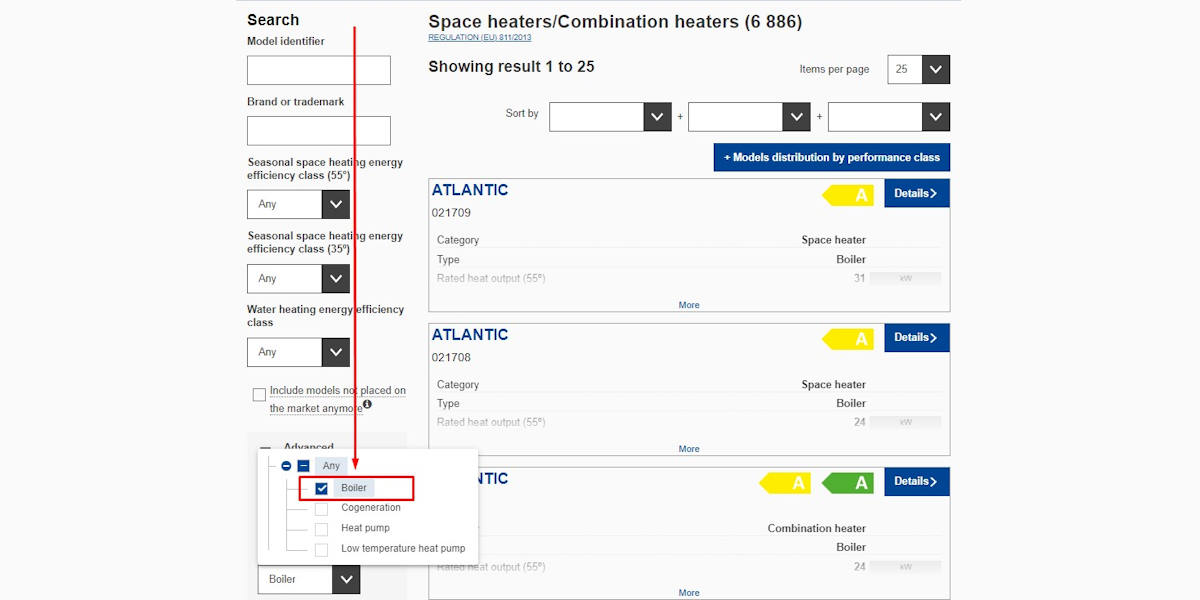
If you’re unable to find a rating for any modern boiler manufactured after 2015, you can search the entire EU energy labelling registry for its percentage scores and efficiency rating.
Select the ‘advanced’ options and check the option for ‘boilers’ before clicking the search button.
SEDBUK Energy Efficiency Rating Scheme
If you have an older boiler installed before 2015, it will most likely have been assessed under the older SEDBUK (Seasonal Efficiency of Domestic Boilers in the UK) rating system.
Instead of a letter score from A to G, a SEDBUK rating is given as a percentage.
How to Find Your Current Boiler’s Efficiency Rating
It’s important to know the efficiency of your existing boiler for two reasons:
- You’ll know how much your boiler’s efficiency, or lack of it, is contributing to your energy bills.
- You can compare energy consumption and annual costs with the latest models to check if it’s worth upgrading.
Unfortunately, ErP labels aren’t very helpful for that as they don’t show the efficiency rating as a percentage, even though the A-G scale is based on it.
So, here’s a few ways to find it:
Look for the Manual
Your boiler user manual is the obvious place to get its energy consumption and efficiency data.
It’s usually listed as a table in the front of the manual and looks like the image above which was taken from my own user manual.
If you can’t find the manual but know the make and model, enter them in Google like this: “make + model + user manual”.
Look for the Make and Model
If you’re unable to find the manual at home or online, all you need is the boiler make and model number which is often printed on the casing.
Once you have that, you can search for the efficiency specifications on the EU energy labelling registry.
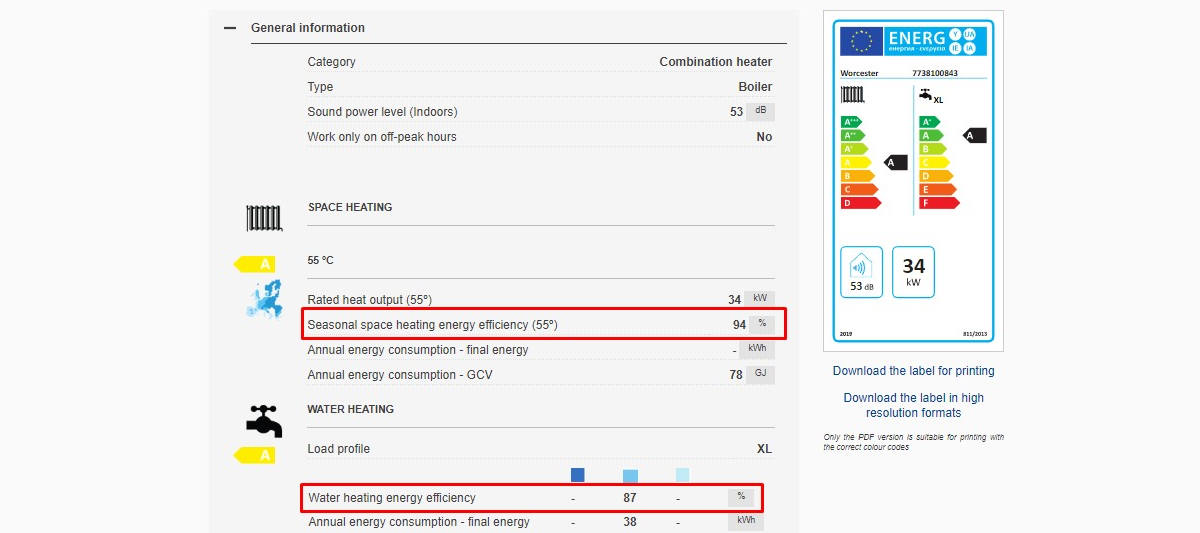
If your was installed before 2015, the next step is to search the Building Energy Performance Assessment database. Simply enter the type of boiler, make and model to view its efficiency ratings for heating and hot water where relevant.
When Was it Installed?
If none of the above helps, try to confirm when it was installed.
Since 2005, there have been multiple changes in legislation that have introduced minimum standards for boiler efficiency. So, knowing when yours was installed can help to estimate its original level of efficiency.
For example, models installed from 2018 will be A-rated and at least 92% efficient.
If installed before 2018 but after 2005, your boiler will use condensing technology that’s around 85% efficient.
Whereas pre 2005 non-condensing models could be as little as 60%-70% efficient.
Ask a Heating Engineer
If none of the above steps have helped, the only way to confirm the efficiency of your boiler is to get a Gas Safe registered heating engineer to check it.
He or she will be able to remove the outer casing and confirm whether it’s a condensing model and even test its efficiency directly.
If you have an older non-condensing boiler, consider replacing it with a newer A-rated model.
How Much Money Could You Save by Replacing It?
Upgrading an old boiler with a new A-rated version could save you as much as 30%-40% on your energy bills according to figures from the Energy Saving Trust.
But there’s a very important caveat to those figures – “depending on the efficiency of your current boiler“.
The table below shows the annual savings of upgrading a D – G rated boiler to the latest A-rated models for each type of property.
Annual A-Rated Boiler Savings by Property
| Old Boiler Rating | Flat | Mid-Terrace House | Bungalow | Semi Detached House | Detached House |
|---|---|---|---|---|---|
| D | £85 | £190 | £210 | £235 | £285 |
| E | £95 | £215 | £230 | £260 | £345 |
| F | £110 | £240 | £260 | £290 | £440 |
| G | £155 | £340 | £370 | £415 | £630 |
Source: Energy Saving Trust
The savings above are only realistic if you’re replacing a much older and inefficient D-G rated boiler. If that is the case for you, then you really could save hundreds of pounds a year.
Otherwise, you’ll need to do some basic calculations to ensure that upgrading makes financial sense.
Here’s how:
- Find out the % efficiency of your current boiler (see previous section). For example 85%
- Find out the % efficiency of your preferred new boiler. For example 95%
- Calculate the ‘efficiency gain’ by taking away the old boiler efficiency from the new. So, 95%-85% = 10%
- Take your annual gas bill and multiply that by the efficiency gain to get your estimated annual saving. For example: £840 gas bill x 10% = £84
Continuing the above example, with an average boiler installation of around £3,000, it would take nearly 40 years to pay for itself. In reality, a boiler wouldn’t be serviceable for that long, so you’d never achieve payback in this scenario.
Of course, if your existing boiler is unreliable or you want to change from one type of heating system to another, then payback times are less critical.
However, if the numbers do stack up for you, the next step is to find the most suitable boiler for your home and budget.
What Are The Most Energy Efficient Gas Boilers in the UK?
The most efficient gas boilers have a condensing function designed to capture more heat from the exhaust gases, resulting in higher efficiency ratings and cheaper energy bills.
My top 5 most efficient boilers were selected based on their efficiency ratings, standard warranty length, and customer satisfaction scores from TrustPilot.
Based on those same factors, I chose the Worcester Bosch Greenstar 8000 Combi for our current boiler which was installed in 2021. It’s given us two years of hassle free use so far with faster hot water, quieter operation and lower bills.
| Make/Model | Type | % Efficiency | ErP Rating | Standard Warranty | Company TrustPilot Rating | Price Range |
|---|---|---|---|---|---|---|
| Viessmann Vitodens 200-W | Combi or System | 94-98 | A | 7 Years | 4.1/5 | £1700 - £2200 |
| Worcester Bosch Greenstar 8000 | Combi or System | 94 | A | 12 Years | 4.6/5 | £1600 - £2900 |
| Vaillant EcoTEC Plus | Combi or System | 94 | A | 10 Years | 4.5/5 | £1200 - £2200 |
| Ideal Vogue Max | Combi or System | 93 | A | 10 Years | 4.9/5 | £1200 - £1700 |
| Baxi 800 | Combi or System | 93 | A | 10 Years | 4.6/5 | £1100 - £1700 |
What to Look for When Buying an Energy-Efficient Boiler
Buying a new boiler is a major investment financially, but also in the future comfort and reliability of your home.
With so many options on the market, it’s important to take the time to understand efficiency ratings, warranties and brand reputations.
Doing research upfront will pay off long-term with a system that reliably and efficiently heats your home for years to come.
What type of boiler suits your property and needs?
The three main types are combi, system, and conventional (or regular). Combi boilers are the most popular choice as they provide hot water on demand and don’t require a separate water storage tank.
The downside of a combi is that they can struggle to meet demand in homes with multiple bathrooms.
For example, families might have to stagger their shower times to avoid low pressure and uncomfortable water temperatures.
What’s the right size or heat output for your home?
Buying a boiler that is too small may struggle to meet your heating needs, while one that is too large can waste energy.
A professional heating engineer can offer advice on sizing the right model to your property and family lifestyle.
What’s the efficiency rating?
As already discussed, an efficient boiler will save you money in the long run by reducing energy consumption.
Look for models with the highest energy efficiency rating you can afford to minimise wastage and bills.
How long is the warranty?
Leading brands will automatically extend their standard warranties if you use an approved installer.
That was the case for my Worcester Bosch model which has a 12 year warranty rather than the standard 10 because the plumber received extra training from the boiler manufacturer.
What heating controls are included?
Modern boilers can come with a variety of heating controls. These can include automatic temperature settings, wireless connections and smart devices.
Look for a boiler with controls that support your lifestyle and have the potential to maximise its efficiency.
Who is the right installer?
Finally, it’s important to consider the best installer for your new boiler.
Make sure to get at least three quotes from Gas Safe registered engineers who have positive reviews from previous customers on third party sites such as Google, Facebook and TrustPilot.
By taking these factors into consideration, you can ensure that your new boiler is energy-efficient and meets your heating needs for the next 15-20 years.
How To Maximise Your Boiler’s Efficiency
There are several things you can do to further improve the efficiency of your gas boiler, prolong its life and save even more money on your energy bills.
Annual Servicing
Just like any other appliance, boilers need regular maintenance to function at their best.
Book an annual service with a Gas Safe registered heating engineer who is familiar with the boiler type and model.
This ensures the system is running efficiently and can help identify any issues before they become more serious.
It’s also good practice to have the system flushed every three years to prevent a build-up of debris and sediment.
System Balancing
Check that your heating system is correctly balanced so the radiators use an equal amount of heat.
Reduce Flow Temperature
Reducing a boiler’s flow temperature can optimize its efficiency by minimising heat loss through flue gasses, maximising heat recovery through it’s condensing capability, and reducing cycling activity (turning on and off).
You could also save money by giving your boiler a lower temperature to reach. Normally set to around 70 degrees by default, Nesta and their Money Saving Boiler Challenge claim it’s possible to save around £112 a year by reducing the setting to 60 degrees.
Bleed Radiators
This helps to ensure the radiators are transferring the right amount of heat instead of being restricted by trapped air.
Maintain Correct Pressure
It’s important to check the pressure of your boiler on a regular basis, and if it drops below the recommended level, usually between 1 and 2 bar, then you should top up the system with water.
Refer to your boiler manual or plumber for instructions on how to do that.
Heating Controls
Modern heating controls such as programmable thermostats, thermostatic radiator valves, and weather compensation monitors enable you to restrict heating to just the times and areas it is needed. They help to minimise wasted heating, energy and money.
Common Questions About Efficient Gas Boilers
Q: What type of boiler is the cheapest to run?
A: The cheapest type of boiler to run is the one that combines maximum efficiency with being the most suitable for your property and lifestyle. For someone living on their own in a flat or small house, a combi boiler will be the cheapest to run.
Alternatively, a large five bedroom house with a growing family might see cheaper running costs with a conventional boiler that’s better able to meet more diverse heating demands.
Q: What is the most energy efficient boiler in the UK?
A: Going by energy ratings alone, the most energy efficient gas boilers in the UK are currently manufactured by Veissmann. Their Vitodens 200-W model is up to 98% efficient.
Q: Is a bigger boiler more efficient?
A: Bigger doesn’t always mean better in terms of boiler efficiency. An oversized boiler can lead to wastage of energy and higher fuel consumption. A correctly sized model will operate more efficiently as it will meet your heating demands without excess energy consumption.
Q: Are high efficiency boilers worth it?
A: Whether high efficiency boilers are worth it financially, depends on how efficient your current boiler is and your level of consumption. For example, replacing a twenty year old non-condensing G-rated boiler with the latest A-rated models will save a mid-terrace property £340 a year according to the Energy Saving Trust.
That’s a substantial saving that could result in a much shorter payback period than replacing a D-rated boiler with savings of £190 a year. So, the more efficient your current boiler is, the lower the savings and longer the payback period will be.
Try the new boiler savings calculator for an estimate of your savings, annual return and payback period.
Q: Are boiler grants still available?
A: Yes, boiler grants are still available for eligible households under the Energy Company Obligation (ECO). It’s run by Ofgem and supports home energy efficiency measures for those considered to be in fuel poverty.
Q: What is a combi boiler?
A: A combi boiler, short for combination boiler, combines both central heating and hot water functions in one unit. Unlike conventional or system boilers, which require a separate tank for storing hot water, a combi boiler heats water on demand. This means that heated water is delivered almost instantly, eliminating the need for a hot water cylinder and reducing heat loss.
As well as being efficient, combi boilers are compact, making them an ideal choice for homes with limited space. There are various types of energy-efficient combi boilers available on the market, offering a range of heating capacities and features to suit different homes.
Q: What is a condensing boiler?
A: A condensing boiler is a type of gas boiler designed to maximise efficiency by using a flue gas heat recovery system. Built-in heat exchangers are able to recycle heat from the exhaust gases that would normally be lost in non-condensing models. The recovered heat is used to pre-heat the cold water entering the boiler, resulting in higher overall efficiency.
Q: What are boiler efficiency ratings?
A: Boiler efficiency ratings, also known as ErP or SEDBUK ratings, are a measure of how energy-efficient a boiler is. They range from A to G, with A-rated boilers being the most efficient. The ratings take into account the boiler’s heat output and energy consumption.