- It's easy for fixed direct debit payments to get out of sync with your energy consumption and cause billing problems.
- If you've had a poor experience with fixed direct debits, some suppliers offer variable payments which only charge you for what you use.
- Smart tariffs can offer more flexible pricing that works with your home setup and reduces billing errors.
It’s not just using less energy that can reduce your bills.
How your account is set up and managed with your supplier can also have an impact on your payments.
The good news is that if you get the balance right, you could save hundreds of pounds a year with discounts and billing that’s closer to your actual usage.
Here’s a checklist of the features to look for in your energy account.
What's In This Article...
Pay by Direct Debit
Gas and electricity unit rates are lower if you pay by Direct Debit, as much as 5%-8% lower.
So at current prices and average usage, you could save well over £1001 a year compared to paying on receipt of a bill.
The reason it’s cheaper is running costs. Here’s what my supplier, Octopus, says:
We pass savings to customers however we can, and different methods of payment are more expensive for us to manage. Not having a Direct Debit costs us more in admin and managing your account.
If you’re unhappy with direct debit because you’ve experienced erratic billing, inaccurate estimates or too much account credit, you might be better off switching to variable payments, which I cover below.
Is Your Direct Debit Set Too High?
Due to ongoing energy market volatility, direct debits have been adjusted upwards for most customers recently.
But as wholesale costs and the price cap have begun to trend downwards, payments can get out of sync with actual usage and charges.
If you are on a fixed direct debit and building up too much credit with your supplier, check that your direct debit isn’t set too high for your usage.
Many suppliers will offer to reduce your direct debit at your annual account review and refund any credit over a certain amount.
If you manage your account online or using an app, adjusting your payments can be as easy as clicking a few buttons.
That’s the case with my supplier, Octopus. I’ve gradually reduced our fixed direct debit payments as price cap rates have been lowered.
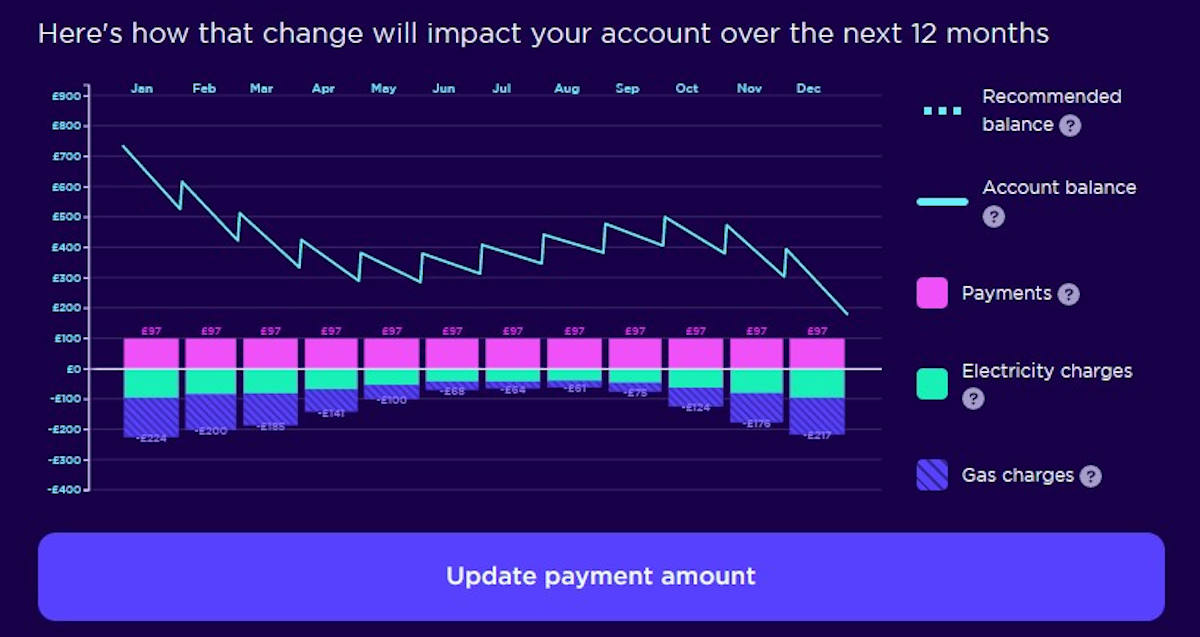
Just be careful not to overdo it and check if your supplier provides a balance forecast tool like the one above from my Octopus account.
Are You on the Right Type of Direct Debit?
Many energy customers are unaware that there are two types of direct debit for paying energy bills.
Fixed Direct Debit (Budget)
The most common type of payment for energy accounts is a fixed direct debit, where you pay the same amount every month throughout the year.
Suppliers set how much you’ll need to pay by dividing your estimated annual usage by twelve.
When it works correctly, a fixed direct debit allows you to build up some credit to help with the higher bills during the peak usage winter months.
Unfortunately, some suppliers’ estimates are more accurate than others, which can lead to payments being set far too high.
That’s not only harder to budget for each month, but also means you’ll accumulate a sizeable credit balance, which I would suggest is better in your bank account than the suppliers.
Pros
- Helps with budgeting and avoiding shock bills during winter months.
- Fewer meter readings required if you don’t have a smart meter.
Cons
- Bills won’t reduce with lower usage in summer months.
- Possible to build up too much account credit if you miss many meter readings.
Variable Direct Debit (Whole Amount)
A variable direct debit only collects payments for what you actually use each month, so they will be cheaper in summer but higher in winter.
Pros
- Only pay for exactly what you use.
- Avoids building up account credit.
Cons
- Bills will be much higher during winter months.
- Requires monthly manual meter readings if you don’t have a smart meter.
- Some suppliers will require a smart meter for variable payments.
- Not all suppliers offer variable direct debits.
Suppliers Offering Variable Direct Debits
Of the suppliers that do offer variable payments, some make it easy to apply either online or via an app. Others will require you to contact them by email or phone to request the change to your billing account.
- 100Green
- British Gas
- Ecotricity
- EDF
- E.on Next
- Good Energy
- Octopus Energy
- Scottish Power
- Shell Energy
- So Energy
- Utilita
If your supplier isn’t listed above, check if they plan to offer variable direct debit payments. If they don’t, you could switch to an energy supplier that does within days.
Are You on the Best Tariff for Your Home Setup and Lifestyle?
Many customers have got out of the habit of comparing energy prices and tariffs because of the market crisis and capping system.
Despite that, the introduction of smart meters has seen an explosion in smart tariffs that are tailored to different lifestyles and home technologies.
For example, Octopus offers seven smart tariffs for electric vehicles, solar + battery storage, heat pumps, or dynamic wholesale-based pricing.
That’s in addition to the traditional choice of variable or fixed tariffs.
That might appear a daunting choice, but switching to one of these new generation tariffs can result in much lower unit rates and bills in the right circumstances.
For example:
- If you have an electric vehicle, dedicated EV tariffs provide super cheap unit rates during off-peak hours, so you can charge your car for a fraction of the cost.
- If you have a heat pump, some tariffs offer multiple daytime periods when you can warm your home at super cheap unit rates.
Send Regular Meter Readings (if You Don’t Have a Smart Meter)
Inaccurate usage numbers can lead to a whole host of billing problems if left unchecked. And it all starts with missed meter readings and supplier estimates.
If you don’t have a smart meter, check that your readings are up-to-date, and set reminders you can’t miss.
I used to set monthly alarms on my mobile phone and record readings by photographing the meters with a timestamp in case of any future issues.
That one tip earned me a £75 refund after switching to a previous supplier who mixed up my readings and overcharged us. They only accepted liability after receiving my meter reading images.
Could You Save Money with a Smart Meter?
A major cause of billing issues is missed or inaccurate meter readings that can lead to suppliers estimating your energy consumption. Over time, that can cause your direct debit to get out of sync with your actual usage, creating further problems:
- You could be paying more than you need.
- If you continue to pay more than you need to, you’ll start to accumulate too much account credit.
- You could be paying less than you should be, leading to account debt and have potential for sharp increases during high peak winter months.
Whatever tariff or payment option you have, timely meter readings ensure your bills are based on accurate usage rather than estimates.
The best way to provide those to your supplier is automatically with smart gas and electricity meters.
Other benefits of smart meters include:
- No more manual meter readings
- No estimates
- More accurate and consistent payments
- A wider choice of energy tariffs
- In-home display unit so you can monitor your energy usage in real time.
If you don’t currently have a smart meter, simply contact your supplier to request an install.
Or use the search tool at SmartEnergyGB.org to find the installation booking page on your suppliers’ website.
If you’re not sure what type of meters you have, try the Citizens Advice meter checker.
My Smart Meter Experience
Our first smart meters were installed in 2022 when I switched us to Octopus Energy for their market leading solar export tariff.
I’ll admit that I was a bit hesitant about the process following some bad press about connection problems with the original SMETS1 models.
Thankfully, ours are the new generation of SMETS2 meters, which after a few minor teething problems, have continued to work without any further issues.
Your Energy Account Checklist
If you’ve not looked at your energy account in a while, it’s easy to make assumptions about the points below.
Work through them one by one and speak to your supplier if you’re unsure about how to make any changes.
- Pay by direct debit
- Check if your direct debit set too high?
- Are you on the right type of direct debit?
- Are you on the best tariff?
- Send regular meter readings
- Get a smart meter
REFERENCES
[1] Source: British Gas. Saving of £130 based on a dual fuel account with average consumption of 11,500 kWh for gas and 2,700 kWh for single-rate electricity at January 2024 energy price cap rates.